
Keyman insurance quote · United Kingdom
Keyman insurance comparison, and how to get a quote
A quote is built from one person and one policy.
Keyman insurance quotes come from insurers, directly or through a broker or adviser (MoneyHelper ↗).
This page gets you ready for a fair keyman insurance comparison: what the cover does for a business, what an insurer will ask, how cover is sized and how to line two quotes up like for like.
You arrive at a key man or key person insurance quote with a number of your own.
Every claim here is our summary of a named external source, linked beside it. Sources change: check the wording at the link before you rely on it.
Information only. We are not an insurer, a broker or an adviser, and nothing here is a quote or advice.
Source, to check at the link: (ABI ↗)
Key person insurance, and what it is for
Key person insurance, also known as keyman insurance or key man insurance, is a policy a business takes out on someone it relies on.
HMRC describes it as cover an employer takes out in its own favour against loss of profits from a key person's death, critical illness, sickness, accident or injury (HMRC ↗).
The business owns the policy, pays the premiums and receives any payout (Legal & General ↗), so no trust is needed (Royal London ↗).
That money keeps the business steady: Legal & General lists covering lost profits, recruiting or training a replacement, keeping customers and suppliers confident, and repaying loans (Legal & General ↗).
The owner
The company takes out the policy
It is the applicant and the plan owner, and it pays the premiums.
The payout
The money goes to the business
If the person insured passes away or is diagnosed with a terminal illness, or a listed critical illness where that cover was chosen.
What it does
It keeps the business steady
Time and money to recruit, protect profits, keep customers and suppliers confident, and repay loans.
Summarised from Royal London (Royal London ↗) and Legal & General (Legal & General ↗); check each at its link.
Three types of cover, and what each pays for
Key person cover comes in three forms, and each pays for something different.
Legal & General sells key person life cover, life with critical illness cover, and Key Person Income Protection (Legal & General ↗).
Life cover pays the business a lump sum (Legal & General ↗), while income protection pays a monthly benefit while the person cannot work (Legal & General ↗).
When you ask for keyman life insurance quotes, the type of cover is one of the first things the insurer needs (Legal & General ↗).
Pick a situation to see which cover responds, then pick a cover for its published limits.
Cover that pays someone other than the business is a different policy.
Shareholder protection helps the other owners buy the shares under a cross option agreement (Royal London ↗), and a relevant life plan pays the employee's family through a trust (Royal London ↗).
If your key person… · what each cover pays for
Life cover
Pays a lump sum- Pays
- A lump sum to the business, which owns the policy (Legal & General ↗)
- The business can use it for
- Lost profits, recruiting or training a replacement, keeping customers and suppliers confident, and repaying loans (Legal & General ↗)
- Most cover
- £10m at Legal & General, subject to underwriting (Legal & General ↗); unlimited up to age 79 at Royal London (Royal London ↗)
- Oldest entry
- 77 at Legal & General (Legal & General ↗) and 77 at Aviva (Aviva ↗)
- Sizing
- Up to 10× salary at Royal London (Royal London ↗)
Life + critical illness
Adds a payout on diagnosis- Pays
- On diagnosis of a specified critical illness, as well as the life cover, where critical illness was chosen at the outset (Legal & General ↗)
- Must cover
- Cancer, heart attack and stroke (ABI ↗), which account for 80% of critical illness claims (ABI ↗)
- Most cover
- £3m at Legal & General (Legal & General ↗); £3m at Royal London (Royal London ↗)
- Oldest entry
- 67 at Legal & General (Legal & General ↗) and 64 at Aviva (Aviva ↗)
- Sizing
- Up to 5× salary at Royal London (Royal London ↗)
Income protection
Pays monthly- Pays
- A regular monthly benefit to the business while the person covered cannot work through illness or injury (Legal & General ↗)
- The business can use it for
- A temporary replacement, protecting profits, or loan repayments (Legal & General ↗)
- Most cover
- £250,000 a year at Royal London (Royal London ↗); £20,833 a month at Legal & General (Legal & General ↗)
- Sizing
- Up to 2.5× earnings for a temporary replacement, or 75% of attributable gross profit, at Legal & General (Legal & General ↗)
- Entry and term
- From 18 to 60, for 5 to 20 years, at Legal & General (Legal & General ↗)
As the insurers describe their own policies: Legal & General (Legal & General ↗), the ABI (ABI ↗) and each insurer's published limits. Information, not a recommendation (FCA ↗): whether a cover suits your business is a question for an FCA-authorised adviser.
Why businesses insure the people they rely on
Every business has people it relies on, whether full-time directors, key employees or fractional executives who work part-time.
Legal & General's research found 59% of businesses believe they would have to stop trading within a year if a key individual passed away or became critically ill (Legal & General ↗).
That is a belief survey, not a failure rate, but it shows how much owners rely on their key people.
Who the person is changes how the cover is sized, so pick one to see it.
Who is being insured
The person the business is built around
In a small company one person can hold the relationships, the decisions and the lender's confidence.
The simplest sizing method is a multiple of earnings: Legal & General says often up to 10 times for life cover (Legal & General ↗).
Scottish Widows counts dividends as well as salary in remuneration for business cover (Scottish Widows ↗).
The person who holds the clients
Sales directors and key account managers whose clients value the relationship.
Here the profit method does the work: Royal London calls profit the main way of calculating a key person's worth, with a normal multiple of 5 times net profit (Royal London ↗).
The person who is hard to replace
People whose skills, knowledge or qualifications take time to replace.
LV= lists recruitment costs among the ways an adviser can set the amount of key person cover (LV= ↗), alongside profits, salary and loan security.
And a fourth case: the loan
Where a loan depends on one person, cover can be sized to the loan the business would need to repay (Legal & General ↗).
Scottish Widows allows full business loan cover for up to 3 directors, owners or key persons (Scottish Widows ↗).
Whether the premiums are deductible turns on HMRC's sole-purpose test (HMRC ↗), so read the tax guide before you assume either way.
How a key person insurance quote comes together
A key person insurance quote comes together in six steps, and most of the preparation happens before an insurer prices anything.
The business names the person and sizes the cover, you choose who to ask, and the insurer underwrites the application.
Step through to see who does what, what you bring and where this page covers it.
Six steps, from first question to a policy in place
Step 1 of 6 · The business
Name the key person
The business needs the person's agreement and a financial relationship with them (Legal & General ↗).
It must be able to show it would lose profits in their absence (Legal & General ↗).
Step 2 of 6 · The business
Size the cover
Every quote asks for a cover amount (Legal & General ↗).
Legal & General's methods include up to 10 times earnings for life cover (Legal & General ↗), up to 5 times the net profit attributable to the person (Legal & General ↗), or a loan to be repaid (Legal & General ↗).
What you bring
- The key person's pay, including regular bonuses and dividends (Scottish Widows ↗)
- The last 2 years' profit figures, which Legal & General routinely averages (Legal & General ↗)
Step 3 of 6 · You
Choose who to ask
Quotes come from insurers direct, specialist brokers or independent financial advisers (MoneyHelper ↗).
Check the firm on the FCA's Firm Checker before you buy (FCA ↗).
Step 4 of 6 · An insurer, direct or through a broker
Get quotes, and compare them
A quote needs a handful of facts about the person and the cover; the health questions come later, with the application (Legal & General ↗).
Before any sale, the firm must set out your demands and needs from what you tell it (FCA ↗).
Two quotes are comparable only when they price the same cover.
What you bring
- The person's date of birth, and whether they have smoked or used nicotine in the last 12 months (Legal & General ↗)
- The cover type, the amount and how long it should last (Legal & General ↗)
Step 5 of 6 · The insurer
Apply, and be underwritten
With consent, the insurer may look at medical records before it decides (Legal & General ↗).
It may ask for a GP's report or a nurse screening where the application does not give it enough to assess (Royal London (adviser) ↗).
Aviva says a fully underwritten policy typically takes several weeks (Aviva ↗), and on a key person case it cannot decide straight away it gives up to £1m of free life cover in the meantime (Aviva ↗).
What you bring
- Medical and family medical history, medication, height and weight (Legal & General ↗)
- A full financial questionnaire, at Aviva above £2.5m of life cover (Aviva ↗)
Step 6 of 6 · The business
The policy is in place
The company is the applicant and the plan owner (Royal London ↗), pays the premiums and receives the proceeds (Royal London ↗).
Legal & General says premiums are guaranteed once the policy has been agreed and is in place (Legal & General ↗).
Whether the premiums are tax deductible is a question of fact for HMRC (HMRC ↗).
Where to get a keyman insurance quote
A keyman insurance quote comes from an insurer, either directly or through someone who arranges cover.
MoneyHelper's list of places to get life insurance quotes includes insurers direct, specialist brokers and independent financial advisers (MoneyHelper ↗).
For key person cover, insurers publish mostly for advisers.
Vitality's key person page is for UK financial advisers only (Vitality ↗), and Legal & General offers advice from its own team by phone (Legal & General ↗).
Whoever you use, check them on the FCA's Firm Checker before you buy (FCA ↗).
Who gives a quote, and who is regulated for what
Prices the risk and pays the claim
MoneyHelper lists getting quotes direct from insurers among the routes to life cover (MoneyHelper ↗).
For key person cover, Legal & General's own team of advisers can advise by phone (Legal & General ↗), while Vitality presents its key person cover on a site for UK financial advisers only (Vitality ↗).
Gets quotes from insurers for you
Specialist brokers are on MoneyHelper's list too (MoneyHelper ↗).
It says brokers “might charge a fee for their services, or they might be paid in commission by insurance companies” (MoneyHelper ↗).
Ask which it is before you start.
- Before the sale
- Every sale must come with a demands and needs test (FCA ↗)
Can recommend what suits your business
Independent financial advisers are on the same list (MoneyHelper ↗).
Writing about critical illness cover, MoneyHelper says “the best way to get what you need is to get advice from an independent financial adviser or specialist broker” (MoneyHelper ↗).
Explains what the numbers mean
- Quotes
- No. Nothing here is a quote or an offer of cover
- Advice
- No. Information given without a judgement on its relevance to you is not advice (FCA ↗)
- Regulated
- Not FCA-authorised. No permissions of any kind
- Paid by
- Nobody. No insurer partnerships, no commissions, no referral fees
What an insurer asks before it prices the cover
Under key person cover the company is the applicant and the plan owner, and the key person is the life covered (Royal London ↗).
The health and lifestyle questions are about that person.
We found no public key person application form, so the checklist uses the questions insurers publish for their personal life cover.
The business has its own part to play.
Legal & General says it needs the person's agreement and a financial relationship with them (Legal & General ↗), and must be able to show it would lose profits in their absence (Legal & General ↗).
Scottish Widows sets the most cover by the person's remuneration or the profit attributable to them (Scottish Widows ↗).
Answer every question in full.
Legal & General says failing to do so may mean you are unable to make a successful claim (Legal & General ↗), and the ABI names non-disclosure of existing medical conditions as a common reason claims are declined (ABI ↗).
Quote readiness · tick what you already have
Does your cover amount need more evidence?
- At or below £2.5m of life cover, Aviva does not ask for a full financial questionnaire. (Aviva ↗)
- Within Legal & General's published maximum of £10m for life cover, subject to underwriting. (Legal & General ↗)
Once the application is in, the insurer may still ask for a GP's report, a nurse screening or blood tests (Royal London (adviser) ↗). While it decides a case it cannot settle straight away, Aviva gives up to £1m of free life cover (Aviva ↗).
What decides a key man insurance quote
Every key man insurance quote is built from facts about one person and one policy.
MoneyHelper lists what protection premiums depend on: the product, how long you take it for, age, whether you smoke or have smoked, lifestyle, health, family medical history and job (MoneyHelper ↗).
No insurer publishes how much each input moves the price.
What they and HMRC do publish about each input is in the panel.
What an insurer asks about
Age, and the published age limits
Aviva says younger people usually pay less because they are less likely to make early claims (Aviva ↗).
Age limits are published even where prices are not.
- Legal & General
- Oldest entry 77 for life cover, 67 with critical illness (Legal & General ↗)
The sum you ask for
Aviva says the more cover you need, the higher your premium will be (Aviva ↗).
The sum also sets how much evidence the insurer wants, and insurers cap it by what the person is worth to the business: the calculator below works through that.
Life cover, or life and critical illness
MoneyHelper lists the type of product among the things premiums depend on (MoneyHelper ↗).
Insurers publish lower sizing multiples for critical illness: Royal London says up to 10 times salary for life cover and 5 times for critical illness (Royal London ↗).
Whether they smoke, or have smoked
MoneyHelper lists whether you smoke or have smoked among the factors premiums depend on (MoneyHelper ↗), and Aviva says smoking or dangerous hobbies can increase premiums (Aviva ↗).
Answer the application's smoking question exactly as it is worded.
How long the cover runs
MoneyHelper lists how long you take the policy out for (MoneyHelper ↗).
For key person life cover there is a tax angle too: HMRC says the term should not extend beyond the period of the employee's usefulness to the company (HMRC ↗).
The inputs only the application shows
Current health, weight, family medical history and job all appear on MoneyHelper's list (MoneyHelper ↗).
Royal London says a family history of some health conditions doesn't always mean you can't get cover, though it can push up the cost (Royal London ↗).
These sit with the underwriter, which is why no web page can give you a real keyman insurance quote.
Size the cover, before the quote
Every quote asks for a cover amount (Legal & General ↗), so work it out first.
This key person insurance for business calculator applies the rules insurers publish: up to 10 times earnings for life cover at Legal & General (Legal & General ↗), up to 5 times the net profit attributable to the person (Legal & General ↗), or the amount of a loan to be repaid (Legal & General ↗).
Royal London caps total key person life cover at the greater of 10 times the salary package or 5 times average net profit (Royal London ↗).
The result is each insurer's published ceiling, not a quote, and nothing you type leaves your browser.
Salary, regular bonuses and dividends; insurers word it differently
Their share of the business's net profit, averaged over recent years
Their share of gross profit
Business borrowing that would need repaying
£420,000 to £600,000
Across 4 published rules that apply to the figures you gave. Each is a ceiling, not a recommendation: the insurer's underwriter sets the real limit.
Add a net or gross profit figure above to see this method.
Add a loan figure above to see this method.
No premium is shown: the price depends on the person and needs an insurer's underwriting. Nothing you type is stored or sent.
How much cover do you need?
There is no single answer, but insurers publish the ceilings their underwriters work to.
Legal & General also allows up to 2 times the gross profit attributable to the person (Legal & General ↗), and routinely uses an average of the last 2 years' profit figures (Legal & General ↗).
Every insurer here publishes a lower ceiling for critical illness, and Zurich's profit rule drops from 5 times profit for life cover to 3 times (Zurich ↗).
If your figure sits above the ceiling, be ready to say why.
Published salary multiples, life cover vs critical illness
Each insurer's published ceiling, not a recommendation; underwriting decides. Sources: Royal London (Royal London ↗), Scottish Widows (Scottish Widows ↗), Zurich (Zurich ↗) (a 2021 guide), Legal & General (Legal & General ↗).
Keyman insurance comparison: quotes like for like
A keyman insurance comparison only works when two keyman insurance quotes price the same cover.
A quote comes before the health questions, so treat it as the starting point for the application rather than the final price (Legal & General ↗).
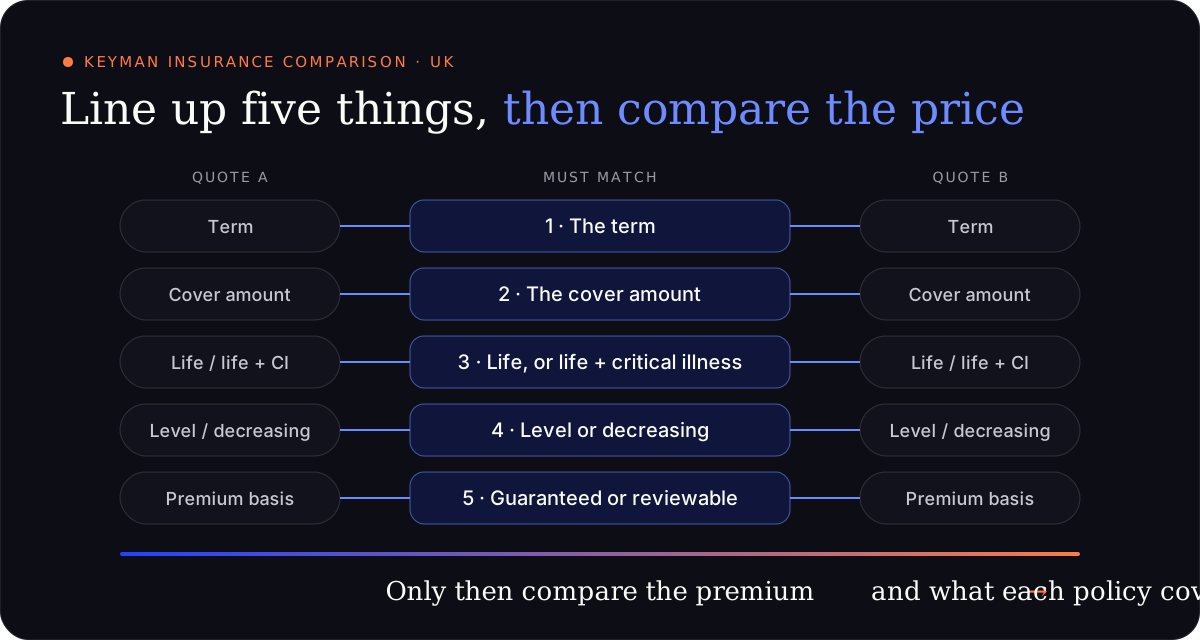
Five things have to match before the premiums mean anything.
Term and cover amount. MoneyHelper lists how long you take the policy for among the things premiums depend on (MoneyHelper ↗), and Aviva says the more cover you need, the higher the premium (Aviva ↗).
Life, or life and critical illness. A critical illness policy must cover cancer, heart attack and stroke to the ABI's minimum definitions (ABI ↗), but MoneyHelper says some policies won't pay out for the early stages of common cancers, and some pay 25% or 50% for less serious illnesses (MoneyHelper ↗).
Read the definitions, not only the price.
Level or decreasing. Level cover stays the same throughout the term; decreasing cover reduces each year, and is designed for repayment mortgages (MoneyHelper ↗).
Aviva says decreasing cover usually costs less than level cover (Aviva ↗).
Guaranteed or reviewable premiums. Guaranteed premiums remain fixed for as long as you have the policy; reviewable premiums are usually reviewed every five years, and at each review are likely to increase in line with inflation (MoneyHelper ↗).
Even then, MoneyHelper says it is not simply a case of signing up to the cheapest policy (MoneyHelper ↗).
Copy two quotes into the panel to check the basis.
Two quotes, like for like · copy each quote's basis in
- Term10 years vs 15 years
- Cover amount£150,000
- Cover typeLife only
- Level or decreasingLevel
- PremiumsGuaranteed
The insurers, and the claims they pay
The market has changed.
Canada Life closed its UK individual term life and critical illness business to new applications in November 2022 (Canada Life ↗), and policies issued by AIG Life are now administered through Aviva (Aviva ↗).
Guardian says its Life Protection is not designed for key person cover (Guardian ↗), and what Hiscox calls key person insurance is personal accident cover of up to £100,000 (Hiscox ↗).
In 2024 UK protection insurers paid a record £8 billion in group and individual claims (ABI ↗), and 97.9% of new individual claims were paid (ABI ↗).
Each insurer's own figure is in its panel, counted its own way, so it is not a ranking.
For an insurer-by-insurer keyman insurance comparison of published terms, see our side-by-side table of each insurer's key person cover.
What each insurer publishes, in alphabetical order
Aviva
- Who can apply
- Limited companies, LLPs, individual partners and sole traders (Aviva ↗)
- While it decides
- Up to £1m of free life cover (Aviva ↗)
- Financial evidence
- A full questionnaire above £2.5m life or £1m critical illness (Aviva ↗)
- Claims paid, 2024
- 97.1% of individual protection claims (Aviva ↗)
- AIG Life
- Policies issued by AIG Life are now administered through Aviva (Aviva ↗)
Legal & General
- Most life cover
- £10m, subject to underwriting (Legal & General ↗)
- Critical illness
- £3m under the Specific Work Task definition, £2m under Own Occupation (Legal & General ↗)
- Oldest entry
- 77 for life cover, 67 with critical illness (Legal & General ↗)
- How to reach it
- Through an adviser, or its own advisers by phone (Legal & General ↗)
LV=
- What it is
- Life insurance on a crucial person, which can include critical illness, paid to the company or partners (LV= ↗)
- Sizing
- Lists profit, salary, loan, recruitment and start-up methods, without published multiples (LV= ↗)
- Claims paid, 2024
- 95% of individual protection claims, including claims in payment (LV= ↗)
Royal London
- Most life cover
- Unlimited up to and including age 79 (£5m with increasing cover) (Royal London ↗)
- Critical illness
- £3m (Royal London ↗)
- Sizing
- Up to 10× salary for life cover, 5× for critical illness (Royal London ↗)
- Income protection
- Key Person Income Protection up to £250,000 a year, or 75% of attributable gross profit (Royal London ↗)
- Claims paid, 2024
- 98.7% of all protection claims (Royal London ↗)
Scottish Widows
- Sizing
- Up to 10× earnings for life cover, typically up to 5× for critical illness (Scottish Widows ↗)
- Remuneration
- Includes dividends and regular bonuses (Scottish Widows ↗)
- Loan cover
- Full cover for up to 3 directors, owners or key persons (Scottish Widows ↗)
- Claims paid, 2024
- 98% of protection claims (Scottish Widows ↗)
Vitality
- How to reach it
- Its key person page is on its adviser site, for UK financial advisers only (Vitality ↗)
- Options
- Three levels of protection (Vitality ↗)
Zurich
- Salary sizing
- Perhaps up to 7× total remuneration for life cover, 5× for critical illness (Zurich ↗)
- Profit sizing
- An underwriter might consider 5× profit for life cover, 3× for critical illness (Zurich ↗)
Are the premiums tax deductible?
It can be.
HMRC's manual sets two conditions: the sole purpose must be meeting a loss of trading income (HMRC ↗) and, for life cover, the policy must be term insurance with no other benefits (HMRC ↗).
Whether the sole-purpose test is met is a question of fact (HMRC ↗).
Tax rules depend on your facts, so check with a qualified accountant before you rely on them. Read our key man insurance tax guide.
Common questions, answered
Explore the guides
More on key person insurance, cover by industry, and the life insurance around it.
- Compare providers
Each insurer’s published key person terms, side by side.
Compare key person insurance → - Calculator
Earnings, profit and loan methods, with the multiples insurers publish.
Open the calculator → - Cost guide
What moves the price of key person insurance, and what is published.
Read the guide → - Limited company
Key person insurance for limited companies: ownership, tax and director cover.
Read the guide → - Business protection
The six covers that keep a company going, and who each one pays.
Read the guide → - Key person risk
How to spot where a business relies on one person, and reduce it before insuring it.
Read the guide →
- Keyman insurance
The complete guide to keyman insurance (key man insurance) for UK businesses.
Read the guide → - Shareholder protection
For partnerships and limited companies: what happens to an owner’s shares.
Read the guide → - Income protection
Cover for when a key employee cannot work through illness or injury.
Read the guide → - Best providers UK
The key man insurance providers, including Aviva, Zurich and Legal & General.
Read the guide → - Key person vs life insurance
Key person insurance against personal life insurance, explained.
Read the guide → - Key person vs relevant life
One pays the business, the other pays the family.
Read the guide → - Executive income protection
Company-paid cover that funds a director’s sick pay.
Read the guide → - Claims
How a key person claim is made, and what the insurer asks for.
Read the guide →
- Construction & trades
Site managers, qualified engineers and the contracts that depend on them.
Read the guide → - Technology & software
CTOs, lead developers and the knowledge they hold.
Read the guide → - Professional services
Partners, senior consultants and their client portfolios.
Read the guide → - Healthcare & dental
Lead practitioners and practice owners.
Read the guide → - Manufacturing
Production managers and quality engineers.
Read the guide → - Startups
Founders, and what investors may ask for.
Read the guide → - Small business
Where one or two people are the business.
Read the guide → - Partnerships
Key person cover when the business is a partnership.
Read the guide →
- Business life insurance
Business life insurance for UK companies: cover for directors and employees.
Read the guide → - Term life insurance
Term life insurance: cover for a fixed period.
Read the guide → - Whole life insurance
Whole life insurance: cover that does not expire.
Read the guide → - Over 50s life insurance
Over 50s life insurance plans, and how they work.
Read the guide → - Mortgage life insurance
Life insurance for your mortgage, and decreasing term cover.
Read the guide → - Family life insurance
Family life insurance to protect a partner and children.
Read the guide → - Pre-existing conditions
Life insurance with a medical history: your options.
Read the guide → - Business health insurance
Private medical insurance for UK businesses.
Read the guide →
Hi, I'm Dan
I built keyperson.quest as an independent information site on key person insurance, also called keyman insurance or key man insurance, for UK businesses.
It is not an insurer, a broker or an adviser.
It takes no commissions and recommends no policy.
Where a page states a fact, it links to the document the fact comes from, so you can check it yourself.
Check it for yourself
Every claim on this page is our summary of one of the documents listed here.
We last checked them against the live sources on 28 September 2026.
The documents are the authority, not this page.
Insurers and HMRC update them, so validate any figure or condition at its link before you rely on it.
- HMRC Business Income Manual, BIM45525 ↗What key person cover is, and when premiums are deductible
- HMRC Business Income Manual, BIM45530 ↗The sole-purpose test, and signs of a non-trade purpose
- Association of British Insurers: 2024 claims ↗Protection claims paid in 2024, and why claims are declined
- ABI Guide to Minimum Standards for Critical Illness Cover ↗The three conditions a critical illness policy must cover, and their share of claims
- Legal & General: key person insurance ↗When the policy pays out, and what the business can use the money for
- Legal & General Key Person Income Protection (adviser page) ↗What key person income protection pays, and what for
- Legal & General Key Person Income Protection policy summary ↗Income protection limits, entry ages and term
- MoneyHelper: how much protection insurance costs ↗What protection premiums depend on
- MoneyHelper: what is life insurance? ↗Where quotes come from, and level and decreasing cover
- MoneyHelper: what is critical illness cover? ↗Guaranteed and reviewable premiums; how brokers are paid
- Legal & General: making life insurance quotes easier ↗What it asks at the quote, and at the application
- Legal & General life insurance FAQs ↗When premiums become guaranteed
- Aviva: do you need a medical to get life insurance? ↗Application questions, medicals and how long underwriting takes
- Aviva life insurance FAQs ↗Level and decreasing cover
- Royal London: what affects the cost of life insurance ↗Health, lifestyle, occupation and family history questions, and what they do to the price
- Royal London: types of evidence (adviser site) ↗GP reports, nurse screenings and blood tests
- Aviva: how life insurance premiums are calculated ↗Age, health, lifestyle and cover amount
- Aviva business protection (adviser site) ↗Evidence limits, free cover and who can apply
- Legal & General Key Person Protection (adviser page) ↗Maximum cover and oldest entry ages
- Legal & General key person adviser guide ↗Sizing cover: earnings, profit and loan methods
- Legal & General life insurance ↗What £25 a month buys by age (personal cover)
- Royal London technical guidance ↗Key person sizing multiples
- Royal London business protection guide ↗Maximum cover and the greater-of cap
- Scottish Widows key person calculator ↗Their published earnings multiples
- Zurich intermediary guide ↗Key person protection (November 2021 guide)
- Drewberry: how much does keyman insurance cost? ↗A broker’s published premium examples, August 2025
- FCA Perimeter Guidance, PERG 5.8 ↗Where information ends and advice begins
- FCA Firm Checker ↗Check a broker or adviser is authorised before you buy
Not financial advice. This page is general information. Before buying insurance, the FCA tells consumers to check the firm on its Firm Checker (FCA ↗). For free guidance, see MoneyHelper.